
A practical framework for choosing the right AI model
We compared 20 AI models across 10 providers on Amazon Bedrock. Higher price did not produce higher quality — several low-cost models matched or beat far more expensive ones on factual reliability.
We compared 20 AI models across 10 providers available through Amazon Bedrock for enterprise article summarisation, to examine how model cost, quality and speed translate into real-world performance. The objective was to determine whether larger or more expensive models consistently deliver better results, or whether lower-cost alternatives can achieve comparable performance when evaluated against the actual requirements of the task.
The results show that higher price does not automatically produce higher quality. Several lower-cost models — including AWS Nova Lite and Nova Pro, OpenAI gpt-oss, Qwen and MiniMax — performed as well as or better than more expensive alternatives on factual reliability. External speed benchmarks similarly indicate that higher price does not necessarily translate into faster performance, with premium and reasoning-intensive models potentially adding both cost and latency without delivering a corresponding advantage for routine workloads.
The broader finding is that model selection should be driven by the requirements of the use case rather than model size, brand or price alone. For routine, high-volume workloads, smaller models may provide the strongest balance of quality, speed and cost, while larger or reasoning-intensive models are better suited to tasks where their additional capabilities create measurable value. More importantly, the effectiveness of an AI system depends on the complete configuration around the model — the prompt, data context, tools, inference settings and validation controls. The best-performing solution is therefore not necessarily built around the most powerful model, but around the model and configuration that most efficiently deliver the required outcome.
Methodology: what we tested and how
We compared 20 AI models available through Amazon Bedrock for cost and speed, and tested the applicable models on the same enterprise summarisation task. Each tested model received the same set of input articles, questions and baseline instructions through its respective API, allowing outputs to be compared on a consistent basis. For benchmark comparability, the initial prompt and context were held constant across models. In client deployments, the prompt and configuration are subsequently optimised for the selected model and use case.
The test included articles with both long and short body text, to assess how models performed with different levels of source information. Each evaluated model was assessed across more than 200 generated summaries drawn from over 10 different source articles, creating a substantial test set for comparing factual reliability across models.
For quality, we measured the hallucination-free rate: how often a model produced a summary without introducing facts or claims that were not present in the source article. Each generated summary was checked against its source article for unsupported factual additions, and the hallucination-free rate represents the percentage of tested outputs that passed this check.
To compare cost, we used Amazon Bedrock pricing from August 2026 and assumed approximately 1,500 input tokens and 120 output tokens per summary. We then estimated the cost of producing 1,000 summaries for each model. Models were grouped into families such as Nova, Llama, Mistral and DeepSeek, with average cost and cost ranges shown where relevant.
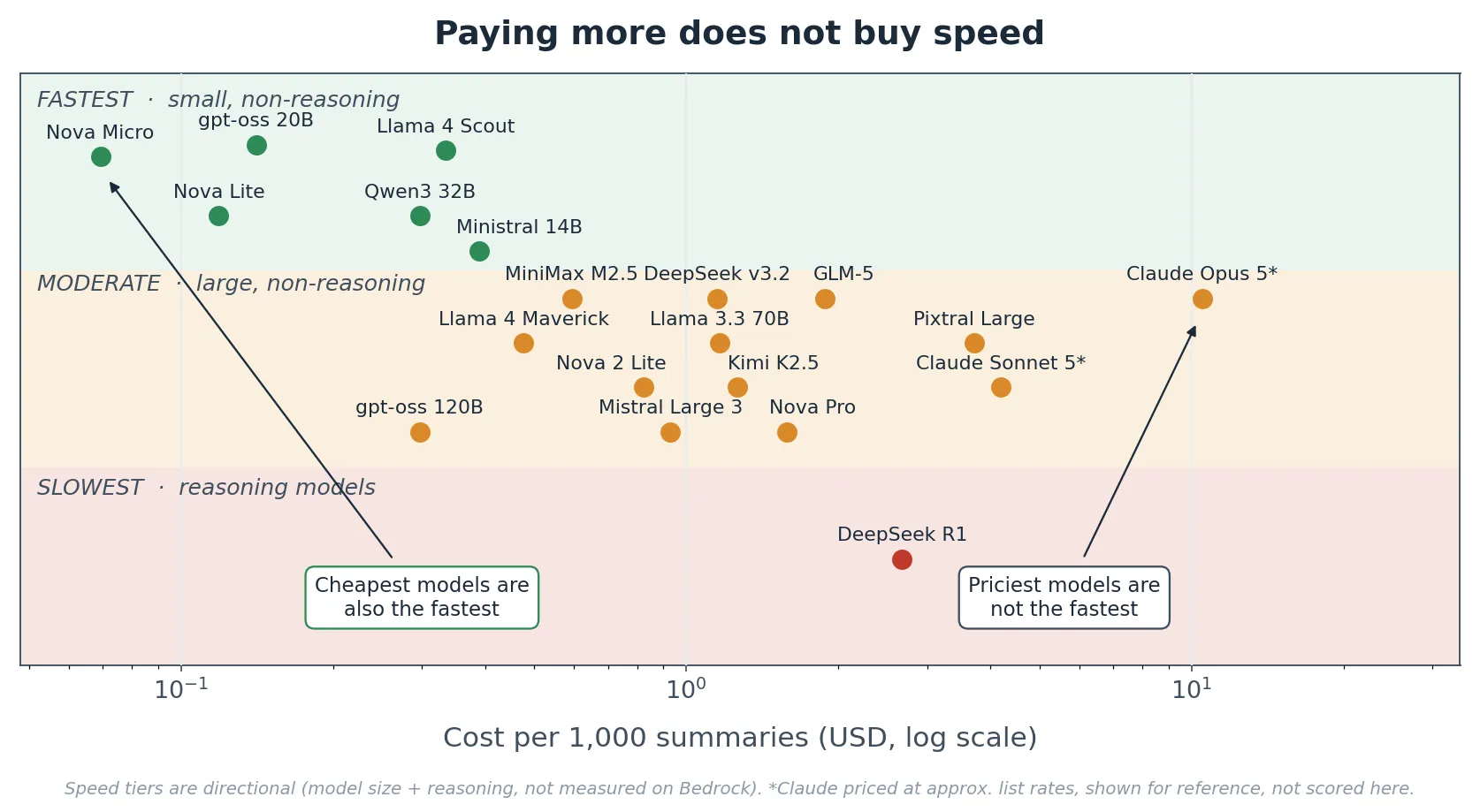
Speed was not measured directly in this test. Instead, we used published external benchmarks to classify models broadly as Fast, Moderate or Slow. These speed tiers are directional, since actual performance can vary depending on model size, reasoning settings, API configuration and infrastructure.
Cost: model economics vary widely, and the price gap is significant
For article summarisation, model costs vary widely. In our comparison, the lowest-cost options start at about $0.07 per 1,000 summaries, while some models cost several dollars for the same volume.
Families such as gpt-oss, Qwen, MiniMax and AWS Nova sit at the lower end of the cost range, while Mistral, GLM and DeepSeek are among the more expensive families in the scored group.
The Claude family is priced higher on Amazon Bedrock. Based on approximate list prices, Claude Sonnet 5 costs about $4.20 per 1,000 summaries and Claude Opus 5 about $10.50. Claude was not scored for factual reliability in this test, so these figures are included only as a cost reference.
There can also be a large cost difference between models within the same family. AWS Nova ranges from about $0.07 for Nova Micro to $1.58 for Nova Pro per 1,000 summaries. Selecting the right model within a family can be just as important as selecting the family itself.
| Family | Models | Cost / 1,000 summaries | Speed* |
|---|---|---|---|
| OpenAI (gpt-oss) | 2 | $0.22 ($0.14–$0.30) | Fast to Mod. |
| Qwen | 1 | $0.30 | Fast |
| MiniMax | 1 | $0.59 | Moderate |
| AWS Nova | 4 | $0.65 ($0.07–$1.58) | Fast to Mod. |
| Meta Llama | 3 | $0.66 ($0.33–$1.17) | Fast to Mod. |
| Kimi | 1 | $1.26 | Moderate |
| Mistral | 3 | $1.68 ($0.39–$3.72) | Fast to Mod. |
| Z.ai GLM | 1 | $1.88 | Moderate |
| DeepSeek | 2 | $1.91 ($1.15–$2.67) | Slow (R1) |
| Anthropic Claude* | 2 | $7.35 ($4.20–$10.50) | Moderate |
*Speed is a directional tier from external benchmarks, not a Bedrock measurement. The Claude family covers Sonnet 5 and Opus 5 at approximate list prices.
Lower cost does not necessarily mean slower performance. Several less expensive model families fall within the fast-to-moderate range, while some higher-cost models are only moderate or slow.
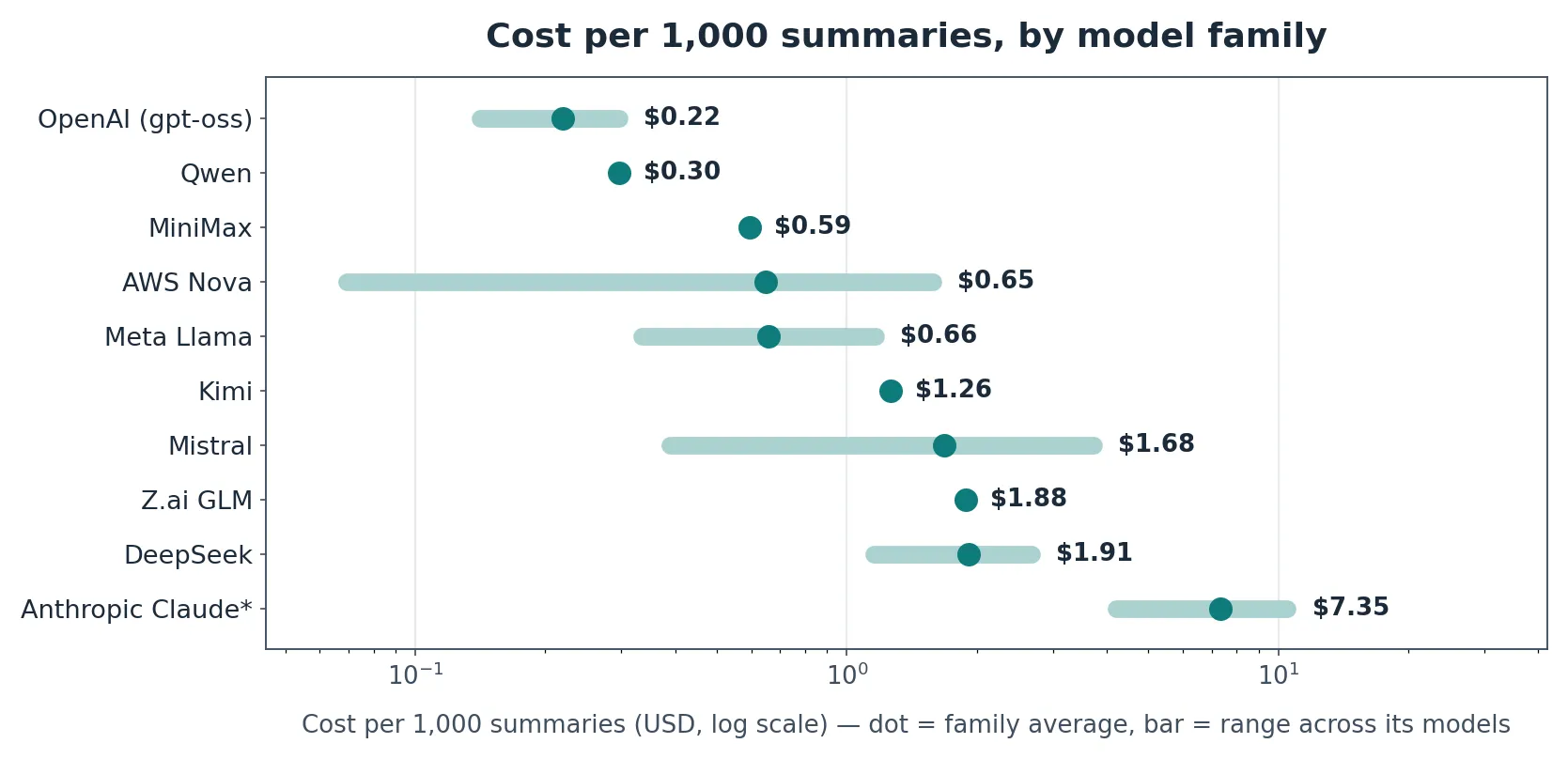
Model costs vary considerably both across and within families. Most lower-cost families cluster below $1 per 1,000 summaries, while Kimi, Mistral, GLM, DeepSeek and Claude sit higher. The wide range within families such as Nova and Mistral also shows that choosing the right model within a family can matter as much as choosing the family itself.
Speed: performance does not follow price
External speed benchmarks also indicate that higher price does not necessarily translate into faster performance. In general, smaller, non-reasoning models tend to respond faster, while larger or reasoning-heavy models may take longer because they perform more computation before producing an answer.
Speed can also vary within the same model family. A lightweight model may be fast, while a larger model from the same family may fall into the moderate-speed range. For this reason, Table 1 uses broad speed tiers rather than exact response times.
Several low-cost models — including Nova Micro, gpt-oss 20B and Llama 4 Scout — fall within the fastest group, while the reasoning-heavy DeepSeek R1 sits in the slowest tier despite costing more than many faster alternatives. The directional comparison does not show a clear relationship between higher price and faster performance. For routine summarisation, a lower-cost model may therefore offer both lower processing cost and faster response times.
Factual reliability: strong results are not limited to premium models
When model cost is compared with the hallucination-free rate, there is no clear pattern showing that more expensive models produce more reliable summaries.
We tested articles with both long and short source bodies. Several lower-cost models performed strongly. Nova Micro and Nova Pro produced no unsupported factual additions in the evaluated summaries, while Nova Lite achieved a 95% hallucination-free rate. gpt-oss, Qwen and MiniMax also performed strongly relative to several higher-cost alternatives.
The pattern was particularly visible when source articles contained limited body text. Higher model cost did not consistently translate into better factual reliability, reinforcing that price alone is a poor predictor of performance for a specific enterprise task.
Public benchmarks may show strong performance for premium models on broader measures of intelligence and factual reliability, but those benchmarks test different tasks and conditions. Their additional cost should be justified by a measurable improvement on the task being performed. For routine article summarisation, the best way to select a model is to test it on the client's own content rather than assume that a larger, more expensive or better-known model will produce the best answer.
Conclusion
For summarisation at scale, a higher price or larger model did not automatically produce a better answer. In this test, models on the cost-quality frontier delivered comparable or better accuracy at lower cost, reinforcing a simple principle: match model capability to the task rather than defaulting to the most premium option.
The model alone is not enough. Even the best frontier model can underperform when instructions are weak or context is incomplete.
Strong performance depends on the right prompt, the right data context, and the right configuration. We therefore recommend evaluating the complete setup, and ensuring human validation so that outputs remain reliable.
Any model can be tested against the client's own benchmark, and the evidence should determine the choice. The goal is simple: use the model that meets the required quality at the best justified cost. Since this analysis is based on a limited test set, and model pricing and capabilities change frequently, results should be revalidated on the client's own content before production deployment.
Why AGR developed this framework
AGR developed this framework because enterprise AI use cases vary widely across sectors, operating models and business requirements. A model that performs well for one task may not be the right choice for another. A high-volume summarisation workflow may need speed, low cost and factual consistency, while a complex reasoning or advisory workflow may require deeper analysis, stronger context handling and tighter validation controls.
As AGR works across a broad variety of clients, industries and problem types, selecting a model based only on popularity, size or price creates unnecessary risk. The wrong model choice can increase cost, slow down delivery, reduce answer quality, or introduce reliability issues such as unsupported claims, inconsistent formatting, or weak source traceability.
The framework gives AGR a repeatable method for comparing models on the factors that matter most to the client: quality, cost, speed, reliability, risk, configuration flexibility and fit with the available data and tools. It moves model selection from assumption to evidence by testing candidate models against real client content and agreed success criteria.
AGR also treats the framework as a living decision process rather than a one-time checklist. Model capabilities, pricing, latency and deployment options change frequently, and client requirements evolve. We continue to improve the framework through testing, production feedback and periodic re-benchmarking so that each recommendation remains aligned with current model performance and client outcomes.
How we choose the right model for each client
AGR does not default to the newest or most expensive model. We benchmark suitable models against the client's actual requirement and select the configuration that delivers the required quality at the best justified cost.
- Set the client benchmark. We define what a good output looks like using client-approved examples or agreed success criteria such as accuracy, completeness, reasoning, format and source traceability.
- Test multiple models on real client work. Candidate models are tested using the same task, context and baseline prompt, so performance can be compared objectively against the benchmark.
- Evaluate the best-fit model. We compare accuracy, consistency, reasoning, speed, risk and cost. The most premium model does not automatically win; the model that meets the required standard most efficiently does.
- Optimise the full configuration. We refine the prompt, context, data, tools and API settings such as temperature, reasoning effort, output token limits and structured response controls where supported.
- Validate before production and monitor continuously. Outputs are human-reviewed and tested for failure cases before deployment. Performance is then monitored and re-benchmarked every quarter as requirements or model capabilities change.

There is no universally best AI model. AGR takes a model-agnostic approach to building custom AI solutions. The best enterprise outcome comes from matching the task with the right model, prompt, context, data, tools and configuration, and proving that choice against real client requirements.
Our objective is not to identify the world’s “best model”. It is to identify the best-performing AI configuration for the client's specific business problem.
Sources and references
- Amazon Web Services, “Amazon Bedrock Pricing,” on-demand model pricing, accessed August 2026. aws.amazon.com/bedrock/pricing
- Artificial Analysis, “Model comparison: intelligence, output speed, latency and price,” accessed August 2026. artificialanalysis.ai/models
- Independent latency benchmarks, 2026: reported time-to-first-token and tokens-per-second vary sharply by provider, hardware and reasoning mode. digitalapplied.com
Cost and accuracy are based on a single controlled test and published Bedrock pricing for August 2026. Speed is directional from external benchmarks. Verify current rates and re-test on your own content before procurement decisions.